Laser Level Buying Guide: Lines, Beams, Range and Kits
Choose a laser level by the layout you need, where you'll use it and how far the line must reach. A cross-line model suits room projects, a 360° model covers more walls, and a rotary laser with a receiver suits larger outdoor layouts.
On this page (9 sections)
- Which laser level type fits your project?
- What do laser lines and beam colors tell you?
- How much working range and accuracy do you need?
- Does self-leveling matter?
- Which mounting and power options help on site?
- When do you need a receiver or a kit?
- Which laser levels suit common buying needs?
- What should you check before buying a laser level kit?
- How do you choose a laser level for your next project?
Choose a laser level by the lines your job needs, the distance they must cover and the conditions where you'll work. A cross-line tool covers basic indoor layout, a 360° model projects around a room, and a rotary laser with a receiver is suited to larger site work.
For hanging shelves, setting cabinets or aligning pictures, a visible horizontal or cross line is often enough. For grading, fencing or work across a large floor, consider whether you need receiver support and broader coverage.
This guide compares the main laser level types, beam visibility, range, accuracy, mounts and kit contents. For a quick overview of common models and uses, start with our line laser guide.
Which laser level type fits your project?
Choose the laser type that projects the pattern your work requires. A cross-line laser handles straightforward room layout, a 360° line laser covers more directions, and a rotary laser suits broad elevation work.
| Type | Best fit | Check before buying |
|---|---|---|
| Cross-line | Shelves, cabinets, pictures and short indoor layouts | Line visibility, mounting and accuracy |
| 360° line laser | Room layouts, tile lines and work across several walls | Number and direction of planes, runtime and mounting |
| Rotary laser | Grading, excavation and larger construction areas | Receiver compatibility, range and kit contents |
| Laser distance meter | Measuring room dimensions and distances | Measuring range, accuracy and measurement functions |
A cross-line laser projects a horizontal and vertical line that meet at a right angle. It can make it easier to keep work aligned on a wall without moving a spirit level between marks.
A 360° model projects one or more full-plane lines around a room. The added coverage can help when you need the same reference across multiple walls, floors or ceilings.
A rotary laser spins a beam to create a level reference around a work area. With a compatible receiver, it can support elevation work where you cannot see the beam clearly from the tool.
A laser distance meter measures distance between points; it does not project a level reference line. If measuring is the main task, see our guide to choosing a laser measure.
How to choose a laser level for home projects
For basic home projects, a self-leveling cross-line laser is a practical starting point. Choose a 360° model if you regularly need a reference around several walls in one setup.
A magnetic mount or tripod thread can make it easier to position the tool at the height you need. Check what comes in the kit, since a bracket, case or tripod may affect how quickly you can set up.
For a picture wall, use a line that spans the planned frame layout and keep the tool steady while marking. Our laser picture-hanging guide covers the setup and marking steps.
For larger rooms, tile layouts or ceiling work, a 360° model may reduce the need to reposition the tool. Compare examples in our best 360 laser level guide.
What do laser lines and beam colors tell you?
The line pattern tells you which directions the laser can reference at once; beam color is one factor in how visible those lines appear. Compare these details against your room lighting and work distance.
A horizontal line gives you a level reference, while a vertical line helps with plumb alignment. A cross-line model combines both, and some tools let you switch individual lines on or off.
Green beams may look brighter than red beams in some conditions. Bosch says the GLL50-20G's green lines are up to four times brighter than standard red beams, while Huepar describes its 3x360 model as using a brighter green laser unit.
Brightness claims don't guarantee that a line will be easy to see in every space. Bright sunlight, reflective surfaces and longer distances can make a beam harder to use, so consider a receiver for outdoor work.
Reflective surfaces can also create confusing reflections. Huepar warns that mirrors, glass and glossy tiles may cause extra lines with its HM03CG, so work away from those surfaces when possible.
How much working range and accuracy do you need?
Choose enough range for the actual work area, then check the accuracy figure and how it is measured. A longer advertised range does not by itself tell you how close the line will be to level across that distance.
Manufacturers may state range under different conditions. A line laser's visible working range, a detector-assisted range and a rotary laser's diameter can describe different setups, so compare like with like.
| Example | Stated range detail | Stated accuracy detail |
|---|---|---|
| Bosch GLL50-20G | Product description gives 65 ft | Product description gives 1/4 in at 30 ft |
| Huepar HM03CG | Up to 98 ft at 100 lux; up to 200 ft with a Huepar detector in pulse mode | ±1/9 in at 33 ft |
| Topcon RL-H5A | 800 m diameter job site | Self-leveling motors accurate to ±10 arc seconds |
| Bosch GLM165-22 | Measures up to 165 ft | Up to ±1/16 in |
Those figures apply to different tool types and functions. The Bosch GLM165-22 is a distance meter, so its measurement accuracy does not describe the accuracy of a projected level line.
The Bosch GLL50-20G has conflicting accuracy figures in its supplied product information: a bullet states 5/16 in at 30 ft, while the description states 1/4 in at 30 ft. Check the current Bosch specifications for the exact figure before relying on it for close-tolerance work.
For a deeper explanation of long-distance use and tolerance, read how accurate a laser level is over long distances.
Does self-leveling matter?
Self-leveling helps the tool set a level line when it is positioned within its leveling range. Look for a clear out-of-level warning and a way to lock the mechanism for transport.
The Bosch GLL50-20G uses a Smart Pendulum System that self-levels, blinks when it is out of level and locks when switched off. Huepar says its HM03CG self-levels within 3° when the pendulum is unprotected, and flashes if it sits outside that range.
Some jobs require a line at an angle, such as stair rails or sloped layouts. Manual mode can let you position a locked tool at an angle, but the beam is no longer a self-leveled reference.
Check the instructions before using manual mode. A line that looks straight on the wall can still be intentionally sloped, so mark the mode and setup clearly if others will work from the same reference.
Which mounting and power options help on site?
Choose mounting and power options that match where you'll place the tool and how long you'll work. A useful mount holds the laser at the needed height, while flexible power can reduce interruptions.
Tripod threads help with freestanding setup, while magnetic mounts can attach to suitable metal surfaces. A bracket with more than one thread size may give you more mounting choices, but confirm compatibility with your existing tripod.
The Bosch GLL50-20G works with two included AA batteries or a separately sold Bosch 3.7V lithium-ion battery. Huepar's HM03CG is rechargeable by USB-C and includes a magnetic bracket and hard case.
Think about carrying and storage as well as setup. A case can protect the tool in transit, while an included mount can save you from buying an accessory just to position the laser.
When do you need a receiver or a kit?
A receiver is useful when the beam is difficult to see or the work area extends beyond comfortable line visibility. For outdoor grading, confirm that the laser supports a compatible detector and that the kit includes the parts you need.
The Huepar HM03CG has an outdoor pulse mode that can extend its range up to 200 ft when used with a Huepar detector. Huepar says a receiver is needed in bright-light conditions or outdoors.
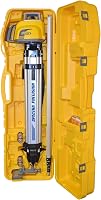
The Topcon RL-H5A package includes an LS-80 receiver, sensor holder and carry case. Topcon describes the rotary laser for grading, excavation and general construction, with an 800 m diameter working area.
A kit can reduce setup gaps, but included accessories differ. Check for the receiver, holder, mount, batteries, charger and case, then make sure each part matches your work and storage needs.
For ground grading or fence layout, a rotary laser may fit better than a room-focused line laser. See our guides to using a rotary laser for grading and setting fence posts with a laser level.
Which laser levels suit common buying needs?
These examples fit different tasks, from indoor alignment to broad site work. Pick by job coverage and setup needs, not by beam color alone.
Bosch GLL50-20G for basic cross-line layout
The Bosch GLL50-20G projects horizontal and vertical green lines for indoor alignment. Its compact body, magnetic mount and AA or optional rechargeable battery support flexible setup.
Bosch says the tool is IP55 rated and that its green lines are up to four times brighter than standard red beams. It also flashes when out of level and locks for transport.
Consider it if you need a straightforward cross-line reference and a built-in way to attach the tool to metal. Check the conflicting accuracy figures in the product information before choosing it for close-tolerance work.
Huepar 3x360 for room-wide lines
The Huepar HM03CG projects one 360° horizontal line and two 360° vertical lines. That pattern can help when a project needs references across more than one wall.
Huepar says the tool runs for up to 8 hours and includes pulse mode for detector use. Its manual mode can support angled layouts, while the unprotected pendulum self-levels within 3°.
Consider it if you want all-around room coverage and rechargeable power. Keep it away from reflective surfaces that may produce extra lines.
Topcon RL-H5A for outdoor elevation work
The Topcon RL-H5A is a rotary laser intended for grading, excavation and general construction. It includes an LS-80 receiver and sensor holder for work where a visible line alone may not be practical.
Topcon gives the tool an 800 m diameter job-site range and IP66 protection. It also describes electronic self-leveling and automatic releveling if the instrument is disturbed.
Consider it when the work area calls for rotary coverage and receiver readings. Its 12.3 lb listed weight makes transport and a stable setup part of the plan.
Bosch GLM165-22 for measuring distances
The Bosch GLM165-22 is a laser distance meter, not a line laser. It measures up to 165 ft and includes functions for distance, area, volume and indirect measurements.
Its color display is backlit, and Bosch describes the housing as rubber overmolded and IP65 rated. It also supports adding and subtracting measurements and rounding results to a useful fraction.
Choose it for measuring spans, not for hanging a level line across a wall. If you need both jobs, plan for a separate line laser.
What should you check before buying a laser level kit?
Check the pattern, range, accuracy, mount, power and accessories against your task. A kit is a good fit when its included parts match the way you'll set up and read the laser.
Use this short checklist:
- Name the job. Decide whether you need a level line, plumb line, room-wide planes, elevation readings or distance measurements.
- Measure the area. Include the working distance and conditions that affect visibility.
- Compare accuracy at a stated distance. Confirm that the figure refers to the function you need.
- Check self-leveling behavior. Find its leveling range, warning signal and transport lock.
- Plan the mount. Confirm thread sizes, bracket type and the height you need.
- Review power and runtime. Check included batteries, charging method and spare options.
- Check receiver support. Confirm the detector is compatible and whether it's included.
- Plan storage and protection. Look at the case and the tool's stated resistance rating.
If your main job is occasional DIY work at home, compare options in our best laser level for home use guide. For a rotary tool aimed at grading, see our best rotary laser level guide.
How do you choose a laser level for your next project?
Choose a cross-line laser for basic indoor alignment, a 360° model for lines around a room, and a rotary laser with a receiver for grading or broad site work. If the task is measuring distance, choose a laser measure instead.
Before you buy, compare the stated accuracy at the distance you need, visibility in your work conditions, mounting options and what's included in the kit. For ground work, follow our guide to leveling yard ground with a laser level.
How we researched this laser level buying guide
We compared the stated features and specifications for these tools against common layout, measuring and grading needs. Confirm current compatibility and specifications with the manufacturer before purchase.
Frequently asked questions
What type of laser level should I buy?
Choose a cross-line laser for level and plumb lines on one wall, a 360° line laser for room layouts, or a rotary laser with a receiver for grading and larger outdoor work. Match the tool to the job's coverage and visibility needs, then check its working range, accuracy and mounting options.
Is a green laser level better than a red one?
Green lines can be easier to see in some indoor conditions, but visibility depends on ambient light, distance and the tool. Compare the manufacturer's stated range and accuracy, and look for a receiver mode if you need to work outdoors or in bright light.
Do I need a laser level with a receiver?
A receiver helps detect a laser when the beam is hard to see, such as outdoors or across a larger work area. Check that the receiver is compatible with the laser and that the tool supports a detector mode before buying a kit or adding accessories.
What does self-leveling mean on a laser level?
A self-leveling laser uses an internal mechanism to set its line level while the tool is within its stated leveling range. If the tool sits too far out of level, it may flash to warn you.
Lock the mechanism for transport and follow the manual's setup instructions.
Can I use a line laser to level ground?
A line laser can help with short, visible layout tasks, but ground grading often needs a rotary laser and receiver to read elevations over a broader area. Choose based on the distance, terrain and visibility, and see our guide to using a rotary laser for grading.