Can You See a Laser Level in Daylight?
Mostly no. A standard line laser is hard to see in direct sun, so daylight work depends on a pulse-mode receiver, a high-power green beam, or a shaded target.
On this page (7 sections)
- Why is a laser level hard to see in sunlight?
- Does a green beam help outdoors?
- How does a receiver make a laser visible in daylight?
- Which laser level setups work outside?
- How do you set up a laser level for daylight work?
- Which outdoor accessories actually help?
- So, can you see a laser level in daylight?
Mostly no. A standard line laser is hard to see in direct sun, so daylight work depends on a pulse-mode receiver, a high-power green beam, or a shaded target.
If you need to know whether a laser level works outside, the answer is yes, but not the way it works in a dark room.
The beam is there, your eyes just can't follow it.
Here's what changes outdoors, which tools solve it, and how to set up so the laser still guides your work.
Why is a laser level hard to see in sunlight?
The sun is simply much brighter than the beam. A laser line stands out in a dim room because the wall is dark behind it.
Outdoors, reflected sunlight off concrete, siding, or grass swamps a thin red or green line within a few feet.
The beam also spreads. A dot that looks tight at 10 ft grows into a blur at 40 ft, and that blur is easy to lose against a bright surface.
DOVOH is clear about the limit on its H3. The maker says the high-power diodes put out 3 times the power of common laser levels, yet still notes the beam is hard to see directly in sunlight.
The company's own answer to "can I use this outdoors in sunlight?" is to pair it with the receiver.
So the practical question isn't whether the line shows up. It's whether you have a way to read the beam that doesn't rely on your eyes alone.
Does a green beam help outdoors?
Yes, but not enough on its own. Green light sits near the peak of human sensitivity, so a green beam reads brighter than red at the same output.
That buys you a few more feet of visibility in shade.
Our guide to the best 360 laser level covers how beam color and plane count shape indoor layouts. Outdoors, the extra brightness helps most in shade, under an overhang, or early and late in the day.
Direct midday sun is a different test. Even the DOVOH H3, with high-power diodes, expects a receiver for daylight work.
Treat green as a visibility bonus, not a daylight solution.
If your outdoor job is short and shaded, a bright green line may be enough to mark a fence post or a deck board. For graded work across a yard, reach for a detector.
How does a receiver make a laser visible in daylight?
A receiver reads a pulsed beam with a sensor, so the line doesn't need to be visible. It shows an arrow or height on a display, telling you to raise or lower the rod until the beam hits center.
This is the real answer to seeing a laser level in daylight. The detector is the eye, and you follow its readout.
Pulse mode switches the laser into a rapid on-off burst that the receiver can pick out from sunlight.
The range jumps too. DOVOH rates the H3 with its DR1 receiver to 400 ft, and notes that figure is receiver range, not how far you can see the beam.
Huepar makes the same point about the W04CG and its LR-8RG receiver.
For rotary lasers, the AdirPro LD-8 does the same job with a dual-sided LCD and a built-in bubble level, and it works in all lighting conditions.
One more thing a receiver gives you is a number you can act on. The AdirPro LD-8 reads out elevation and grade sensitivity, so it tells you how far off the mark the rod is and in which direction.
That is more useful than a faint line you have to squint at from 30 ft away.
Which laser level setups work outside?
Here are three setups we compared that handle daylight jobs in different ways.
Best for long outdoor jobs with a built-in receiver
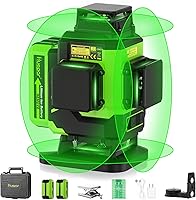
The Huepar W04CG pairs 4 x 360° green planes with a receiver that stretches the working range to 400 ft in pulse mode. Two horizontal and two vertical planes cover walls, ceilings, floors, and corners, and the bottom plane reaches as low as 1/2 in for floor work.
The liftable base adjusts from 1 in to 3.54 in, and an electric rotating base runs at 3 speeds for fine alignment. You can change modes from up to 65 ft with the Huepar App or the remote, and the backlit LCD panel works with gloves on.
The vertical planes cross at 90°, which handles squaring a room or setting a corner post, and the touch panel shows battery life and tilt angle so you can catch a shifted setup before it spoils a run.
The kit also ships with a hard carry case, a magnetic bracket, a steel sheet, and a drop-proof rope, so the whole set survives a truck bed and a rough site. A practical read on Huepar's lineup is in our Huepar laser level review.
For outdoor framing, grading, or deck work, this is the setup to start with.
Best for rotary lasers and graded work
The AdirPro LD-8 is a detector rather than a laser. It works with most standard red rotary lasers and reads a beam out to 2,000 ft depending on the laser, which suits grading and site work where you move along a rod.
The dual-sided LCD shows elevation, grade sensitivity, audio, and battery status, and a built-in bubble level keeps the rod plumb. Accuracy is ±1/16 in, and the rod clamp comes included.
Its IP55 housing handles dust and water jets, and a 9V battery gives about 40 working hours with auto-shutoff after 10 idle minutes. The rubber casing protects the detector from knocks when you set it down on a grade stake.
If you already own a rotary laser, this is the daylight upgrade.
Best for a bright 360 line and receiver kit
The DOVOH H3-360G-KIT bundles a 360 self-leveling laser with a DR1 receiver and rates the pair to 400 ft. The maker says the high-power diodes give 3 times the output of common laser levels, and the kit adds a target plate and green glasses for spotting the line outside.
Cushioning rubber wraps the core assembly in a double shockproof design, and dual 2600mAh batteries cut down on charging breaks. The batteries swap fast, so one can charge while the other runs.
The DR1 works with any DOVOH laser and needs a 10 KHz pulse from other brands.
The kit ships in a hard toolbox with a rotary base, magnetic bracket, charger, and Type-C cable. It's a sensible pick if you want one box that covers indoor layout and outdoor checks.
If you're working to a budget, compare it with the picks in our laser level under 100 guide.
How do you set up a laser level for daylight work?
Get the receiver on the rod first, then turn on pulse mode. A laser that isn't pulsing won't register, and you'll waste time hunting a beam you can't see.
- Set the laser on stable ground and let it self-level.
- Switch to pulse mode as the maker requires.
- Mount the receiver on the grade rod and turn it on.
- Slide the receiver until the display reads center.
- Mark the height, then move to the next point.
Keep the laser out of direct sun if you can, and shade the receiver display so you can read it. For long runs, check the setup once with a second reading before trusting the marks.
A laser level for home use rarely needs this gear, but an outdoor deck or fence does. See our picks for the best laser level for home use if your projects stay indoors.
Which outdoor accessories actually help?
Shade, a target plate, and glasses help a little; a receiver helps the most. The target plate catches the beam and makes the dot easier to spot, and tinted glasses raise contrast against bright surfaces.
DOVOH includes both in the H3 kit, which shows how much the maker expects daylight users to need them. They're useful for close work like setting a post or checking a line on a wall.
They won't carry you across a yard.
For anything past roughly 20 ft in sun, a detector is the only practical tool. The AdirPro LD-8 for rotary setups or the receivers in the Huepar and DOVOH kits do the real work.
So, can you see a laser level in daylight?
Not as a line, but yes as a working tool. The beam disappears in sun, and a receiver reads it instead, giving you accurate heights across long distances.
Green beams and shaded targets extend visibility a little, and pulse mode with a detector covers the rest.
Pick the Huepar W04CG if you want one 360 kit that handles layout inside and grades outside. Choose the DOVOH H3 if the bundle with glasses and a target plate fits your jobs.
Add the AdirPro LD-8 if you already run a red rotary laser.
Before you buy, check that any receiver you rely on is rated for your laser's pulse frequency. DOVOH's DR1 needs 10 KHz from other brands, and a mismatched pair won't read.
Frequently asked questions
Is a green laser level easier to see outside than a red one?
Yes. Green beams look brighter to the eye at the same power, so they stay visible a little farther in shade.
Direct sun still washes both out, which is why a receiver or shaded target remains the reliable outdoor method.
What is pulse mode on a laser level?
Pulse mode fires the beam in rapid bursts so a receiver can detect it. The Huepar W04CG and DOVOH H3 both need pulse mode switched on to use their receivers, and that is what gives them their long outdoor range.
Do I need a receiver for outdoor leveling?
For anything measured in tens of feet, yes. The AdirPro detector reads a rotating beam up to 2,000 ft depending on the laser and works in all lighting.
A receiver turns an invisible outdoor line into an on-screen height reading.